Noises in the Attic: Raccoon or Squirrel?
Scratching in the attic at night and scratching in the attic at dawn are usually two different animals.
Before anyone climbs a ladder, the hour and the season narrow it down.
This page is a short way to sort a raccoon from a squirrel using published facts about each.
Write down what you notice for two or three days, then call Detroit Raccoon Removal or send the form. The notes save time on the call.
Step 1: what time is it?
| You hear it | Fits |
|---|---|
| After dark and through the night | Raccoon, which is typically nocturnal,1 or flying squirrel, also nocturnal4 |
| Daylight, especially early | Gray squirrel2 or red squirrel, which is diurnal3 |
Step 2: what month is it?
Young animals make their own noise, and the months differ by species.
- Raccoon. Mating runs January to March. Kits begin walking four to six weeks after birth.1
- Fox squirrel. The earliest litters appear in late January, and most births come in mid-March and July.5
- Red squirrel. Breeding generally peaks from March to August.3
Call about a raccoon (313) 370-4445
Step 3: look from the ground
Stay off the roof.
From the yard, check the places the National Park Service tells its inspectors to check: siding, eaves, soffits, cornices, gables and the chimney.6
Note any tree limb that overhangs the roof or comes within about six feet of it; the same manual treats those as pathways.6
Step 4: decide who to call
If the notes point to a raccoon, read raccoon in the attic. If they point to squirrels, read squirrel removal.
If you cannot tell, call anyway and say so.
This guide does not cover bats or mice.
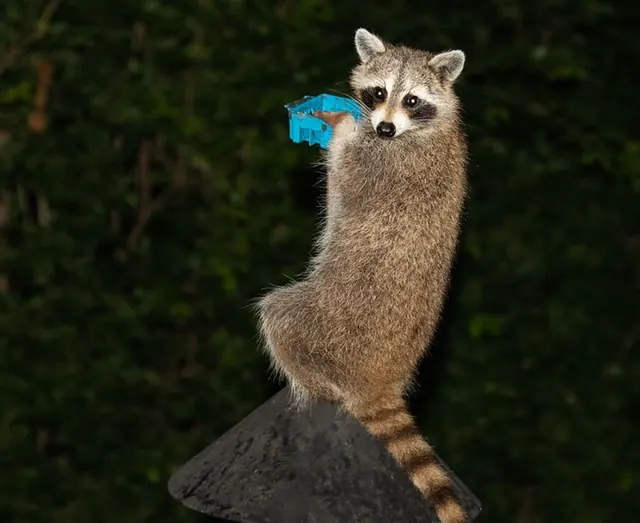
Photo: Mike Carlo/USFWS, public domain.
Why a litter changes the job
Raccoons mate from January to March, with a peak in February, and a female generally raises one litter a year.
Average litters run from two to five. Kits start walking at four to six weeks and can climb at about seven.1
Until then they stay where the mother left them, so removing her alone leaves the kits in the attic.
More on the raccoon in the attic page.
Sources
Sources
- USDA Forest Service (Fire Effects Information System). Procyon lotor (Tesky, J.L. 1995), Fire Effects Information System species review.
- NPS (Big Thicket National Preserve). Eastern Gray Squirrel.
- USDA Forest Service (Fire Effects Information System). Tamiasciurus hudsonicus (Sullivan, J. 1995), Fire Effects Information System species review.
- NPS (National Capital Region Inventory & Monitoring Network). Flying Squirrels: A Field Note.
- USDA Forest Service (Fire Effects Information System). Sciurus niger (Tesky, J.L. 1993), Fire Effects Information System species review.
- NPS (Natural Resource Stewardship and Science). Rodent Exclusion Manual. Mechanical Rodent Proofing Techniques: a training manual for National Park Service Employees (Badzik, DiSalvo, Buttke, Chase; September 2014; 2019 accessible version).
Raccoon or squirrel in the attic, walls or chimney?
Call the line (313) 370-4445